The Ultimate Guide to the Short Throw Projector: Big Screen Magic in Small Spaces

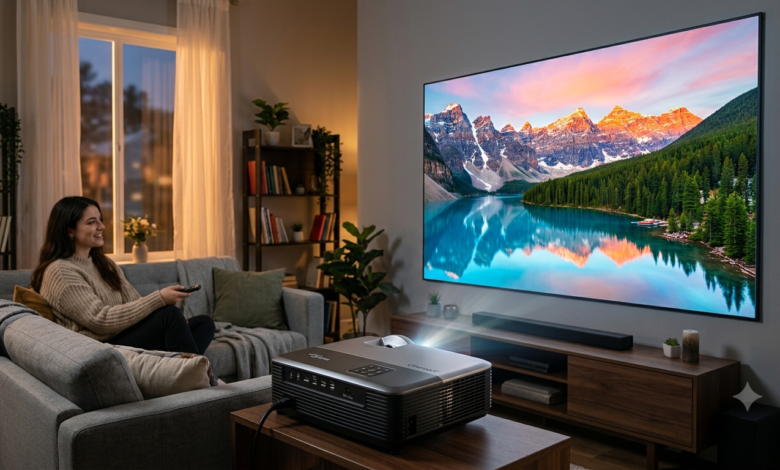
Short Throw Projector If you have ever dreamed of setting up a massive home theater but abandoned the idea because your living room resembles a cozy studio apartment rather than a commercial cinema, you are not alone. For decades, getting a true 100-inch or 120-inch display meant mounting a heavy machine to your ceiling, running fifteen feet of cables through the drywall, and praying nobody walked in front of the lens mid-movie. Thankfully, display engineering has changed the game completely.
Enter the short throw projector. This specialized category of display hardware flips traditional home theater design on its head, using advanced wide-angle lenses to project massive, crisp images from just a fraction of the distance required by old-school setups. Whether you want to upgrade your living room, build an immersive gaming den, or make your office conference room more functional, understanding how a short throw projector operates is your ticket to a seamless, high-impact upgrade.
Let us break down everything you need to know about choosing, setting up, and maximizing a short throw projector so you can cut through the marketing noise and pick the perfect unit for your space.
What Exactly Is a Short Throw Projector?
To understand why a short throw projector is such a massive leap forward, we have to look at standard projection technology. Traditional long-throw machines require roughly 8 to 10 feet of distance to create a 100-inch image footprint. If a pet or a human walks anywhere in that 10-foot light path, they cast an annoying shadow across the screen and get a face full of blinding light.
A short throw projector solves this spatial puzzle by utilizing a specialized, highly curved wide-angle lens (often called a “fish-eye” lens). This geometric innovation allows the light engine to spread its optical beam rapidly over a minimal distance. Instead of sitting at the back of the room, a short throw projector typically needs only about 3 to 5 feet of clearance to achieve that identical 100-inch image.
Taking things a step further, the market also features ultra-short throw (UST) projectors. Often marketed as “Laser TVs,” these hyper-specialized devices use advanced internal mirrors to project images from mere inches away from the wall. By placing the hardware directly beneath your screen on a media console—exactly like a traditional TV or soundbar—the short throw projector ecosystem eliminates long cable runs and structural ceiling mounts entirely.
The Core Benefits of Short Throw Technology
The most immediate benefit of a short throw projector is its sheer space efficiency. It democratizes the large-screen entertainment experience for individuals living in urban apartments, dorm rooms, or homes with awkward architectural layouts. You no longer need a dedicated, cavernous basement to enjoy a premium home theater experience; any blank wall in a modest room instantly transforms into a high-definition canvas.
Another massive practical advantage of a short throw projector is the complete elimination of shadow disruptions and eye glare. Because the unit sits so close to the projection surface, it is physically impossible for foot traffic to cross into the light path. This makes it an absolute favorite for interactive classroom teaching, business presentations, and active gaming setups where players might be moving around the room.
Finally, a short throw projector vastly simplifies your audio and cable management. Because the device sits near the front of the room alongside your media console, connecting game consoles, streaming sticks, and external sound systems is straightforward. There is no need to run expensive, active high-speed HDMI cables across ceilings or through flooring, keeping your entertainment setup clean, safe, and highly aesthetic.
Key Technical Specifications to Watch For
When shopping for a short throw projector, the single most critical metric to analyze is the throw ratio. This number represents the relationship between the distance from the lens to the screen and the width of the projected image. While standard projectors carry throw ratios well above 1.5:1, a high-quality short throw projector boasts a ratio between 0.5:1 and 1:1, meaning it can create a wide, immersive image from an incredibly short distance.
Brightness is another vital metric, measured uniformly in ANSI lumens. Because a short throw projector is frequently deployed in multi-purpose living spaces rather than pitch-black, windowless basements, you need sufficient luminance to combat ambient room light. For a satisfying experience during daytime viewing or with casual ambient lighting turned on, target a model pushing at least 2,200 to 3,000 ANSI lumens.
Lastly, pay close attention to the light engine architecture: Lamp, LED, or Laser. While older lamp-based systems are budget-friendly, they require expensive bulb replacements every few thousand hours. Modern short throw projector units increasingly rely on solid-state LED or premium triple-laser technology, delivering near-instantaneous power cycles, vastly superior color gamuts, and a robust lifespan often exceeding 25,000 hours of continuous use.
Quick Facts Table
| Feature Category | Short Throw Projector Details |
| Average Throw Ratio | 0.5:1 to 1:1 (UST models drop below 0.4:1) |
| Typical Distance for 100″ Image | 3 to 5 feet from the wall surface |
| Primary Light Source Options | Laser, LED, or Traditional UHP Lamp |
| Optimal Screen Pairing | Fixed-frame tensioned or ALR (Ambient Light Rejecting) |
| Key Gaming Advantages | Ultra-low input lag, shadow-free movement |
Why a Dedicated Screen Changes Everything
A common mistake newcomers make when unboxing a premium short throw projector is projecting directly onto a standard, painted drywall surface. While this works in a pinch, it severely handicaps the performance of your hardware. Because short throw lenses project light at extreme, steep angles, any minor microscopic texture or bow in standard drywall will cause noticeable image distortion and focus gradients.
To get the most out of your investment, pairing your short throw projector with a perfectly flat, tensioned projection screen is essential. For spaces with uncontrolled windows or bright overhead fixtures, an Ambient Light Rejecting (ALR) or Ceiling Light Rejecting (CLR) screen is a complete game-changer. These specialty surfaces feature microscopic, triangular ridges designed to swallow stray light from above while reflecting the projector’s light straight toward your eyes.
Investing in a high-quality screen ensures that your short throw projector maintains deep, cinematic contrast levels and vibrant color saturation, even during the middle of the day. The result is a setup that rivals the visual punch of a massive OLED television but at a significantly larger scale and a lower cost per diagonal inch.
Frequently Asked Questions (FAQ)
Can I use a short throw projector on a regular white wall?
Yes, you can project onto a flat wall, but it is not ideal for maximum performance. Because a short throw projector shoots light upward at a sharp angle, any slight bumps, textures, or imperfections in your drywall will cast tiny shadows, leading to geometric distortion and uneven focus across the screen.
What is the difference between a short throw and an ultra-short throw projector?
The primary difference is the placement distance. A short throw projector has a throw ratio between 0.5:1 and 1:1, requiring roughly 3 to 5 feet of distance for a 100-inch image. An ultra-short throw (UST) projector uses specialized internal mirrors with a ratio below 0.4:1, allowing it to sit just inches away from the wall.
Are short throw projectors good for competitive gaming?
Absolutely. Many modern short throw projector models are engineered specifically with gamers in mind, offering dedicated game modes that drop input lag down to competitive levels (often under 16 milliseconds at 4K/60Hz). Plus, you can play motion games without ever worrying about casting your own shadow on the screen.
Do short throw projectors support native 4K resolution?
Yes, there are plenty of high-end 4K options on the market. Some utilize native 4K imaging chips, while many mainstream models leverage fast-switching pixel-shifting technology to achieve full 4K UHD pixel density on screen, delivering incredibly sharp text and vivid movie details.
How long do the light sources last in these devices?
If you select a modern solid-state laser or LED short throw projector, the light engine is typically rated to last between 20,000 and 30,000 hours. In real-world terms, that means you could run the machine for 4 hours every single day for over fifteen years before the light source shows any major degradation.